The Attack of Robots, Elephant, Banksy, and Heat
Editor’s Words
We’re back! We played quite a few games last weekend, so we had to skip an issue.
Publishing a weekly newsletter requires a lot of work. It would not have been possible without Claude, one of the best AI tools in 2026. If you are into creating content - whether that’s text, audio, or video, AI can be a huge productivity boost and a total game changer.
While being a weekly digest for curious kids, the Sunday Blender is also an experiment on how much AI can level the playground of content sourcing, curation, synthesizing, publication, and marketing. Claude helped me write 7 Python scripts to automate several repetitive and tedious steps that would otherwise take me not hours but days to finish.
I have shared my experience on this fun journey at a recent workshop with Peking University - “How Content Creators Should Use AI in 2026”.
Take a read if you are interested or share that with your friends in media.
Tech
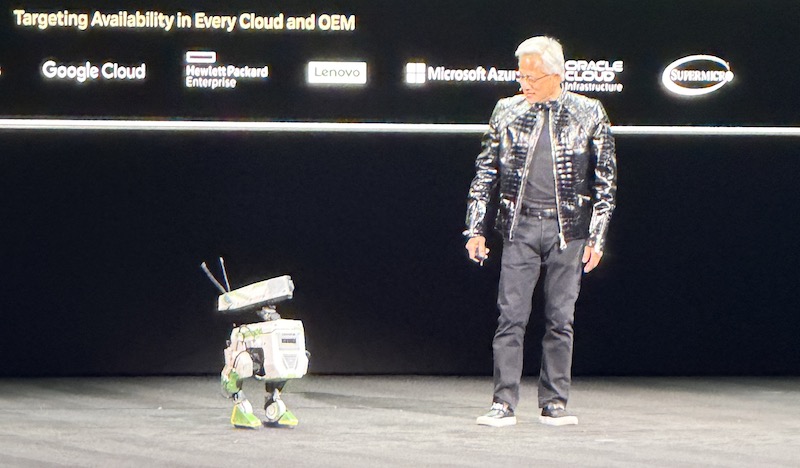
Nvidia founder and CEO Jensen Huang opened CES 2026 (Consumer Electronics Show) at the Fontainebleau Las Vegas, declaring that AI is scaling into every domain and device. “Computing has been fundamentally reshaped,” Huang said, noting that “$10 trillion of computing is now being modernized.” “The ChatGPT moment for physical AI is here — when machines begin to understand, reason and act in the real world,” Huang announced. He unveiled Rubin, Nvidia’s next-generation AI platform now in full production, promising to deliver AI tokens at one-tenth the cost of previous platforms. He also introduced Alpamayo, an open reasoning model family for autonomous vehicles, with the Mercedes-Benz CLA becoming the first passenger car featuring the technology.
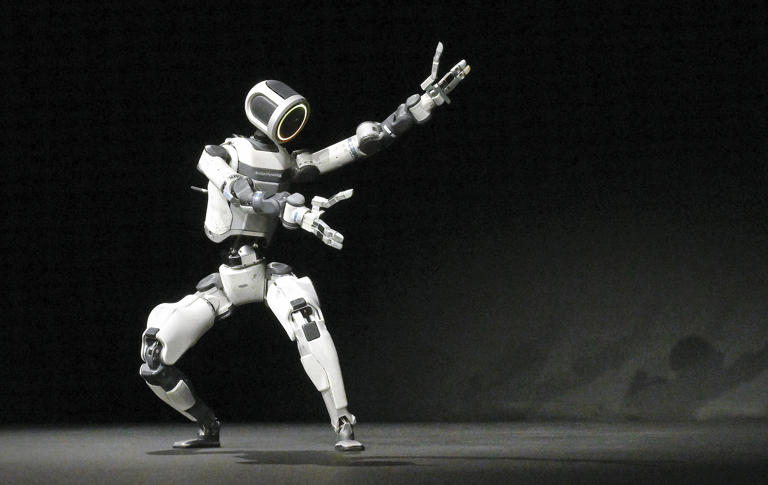
After 30+ years of R&D, Boston Dynamics unveiled the production Atlas at CES 2026. The all-electric humanoid has 56 degrees of freedom, allowing its head, torso, and hands to rotate 360° — moving more efficiently than humans in tight spaces without turning its whole body. Four-fingered hands with tactile sensing in fingers and palms enable dexterous manipulation. When battery runs low, Atlas autonomously swaps its own batteries and returns to work. It can rise from a folded position to minimize idle footprint, and limbs are field-replaceable in under five minutes. Once one Atlas learns a task, the skill deploys instantly across the entire fleet. First deployments go to majority shareholder Hyundai and new AI partner Google DeepMind. Hyundai plans to use Atlas in its car plants by 2028 for parts sequencing, expanding to component assembly by 2030.

Lego unveiled its Smart Play system at CES 2026 (Consumer Electronics Show), calling it the most significant innovation since the Minifigure debuted in 1978. The Smart Brick is a standard 2x4 brick packed with a tiny 4.1mm chip, sensors, accelerometers, and a miniature speaker—all enabling screen-free interactive play. Using copper coils, magnetic fields, and Bluetooth, Smart Bricks communicate with Smart Tags and Smart Minifigures to produce sounds and lights in response to movement. Launching March 1, 2026, the first sets feature Star Wars themes, with prices ranging from $70 to $160. Some play experts have raised concerns about digitizing a traditionally analog toy, though Lego emphasizes this complements rather than replaces classic building.
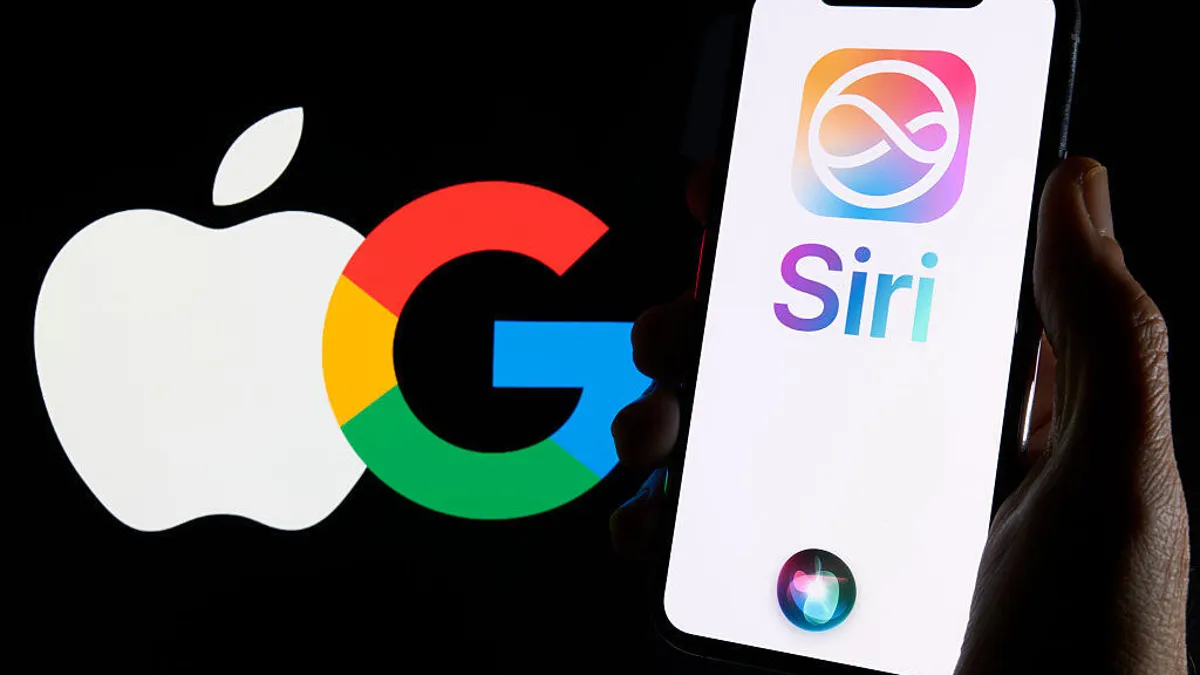
When Apple launched Siri in 2011, it was the first mainstream voice assistant - years ahead of Google Assistant or Amazon’s Alexa. Fourteen years later, that lead has evaporated. Apple and Google announced a multi-year collaboration where the next generation of Apple Foundation Models will be based on Google’s Gemini. Siri’s brain will now run on a competitor’s technology. Apple is paying roughly $1 billion annually for access. After careful evaluation, Apple determined that Google’s AI technology provides the most capable foundation — an acknowledgment that its own models weren’t cutting it. Internal evaluations revealed Siri was failing complex queries about 33% of the time. For a company that built its identity on vertical integration, this is a pragmatic concession: partner now, compete later. The pioneer has become the customer.

In 2021, Facebook rebranded itself as Meta, staking its entire identity on a virtual world that never materialized. Four years and $73 billion later, the company is quietly dismantling that vision—cutting 1,500 Reality Labs jobs this week, shuttering VR game studios, and redirecting resources toward AI wearables and chatbots. The pivot marks one of the most expensive strategic retreats in tech history. Meta is now betting that AI-powered Ray-Ban smart glasses, not VR headsets, will define the next computing platform. Whether this represents hard-won wisdom or simply another hype cycle remains Silicon Valley’s billion-dollar question.
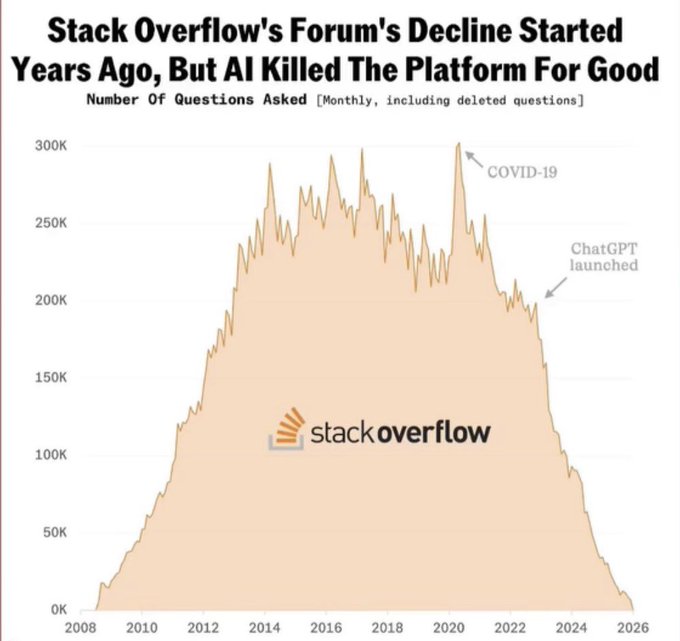
Launched in 2008, Q&A forum Stack Overflow quickly became the go-to hub for programmers seeking answers to coding problems, fostering a community-driven repository that powered everything from startup scripts to enterprise software. For years, it was an almost universal experience: find a thread, copy the top-voted answer, run it, problem solved. At its peak around 2014, the platform received over 250,000 questions per month. By early 2026, monthly questions have collapsed to about 300 — levels not seen since 2009. Developers are switching en masse to AI assistants like GitHub Copilot and Claude Code directly that answer without the platform’s notoriously hostile culture where newbies were routinely humiliated for asking “basic” questions. Ironically, Stack Overflow’s own content trained the very AI models now supplanting it.
On January 7, 2026, millions of Mac users discovered their Logitech mice and keyboards had suddenly lost all custom functionality—button mappings, gestures, and scroll settings reverted to defaults or stopped working entirely. The culprit: an expired Apple Developer Certificate that Logitech failed to renew. The certificate, last renewed on January 5, 2021, expired on January 6, 2026 — and because macOS blocks apps with expired certificates, the software froze at launch. The outage lasted over 12 hours, disrupting workflows globally. The incident exposed a troubling reality: our increasingly sophisticated tech ecosystem rests on fragile foundations. A single overlooked calendar reminder — renewing a certificate — paralyzed millions of devices worldwide.
Global
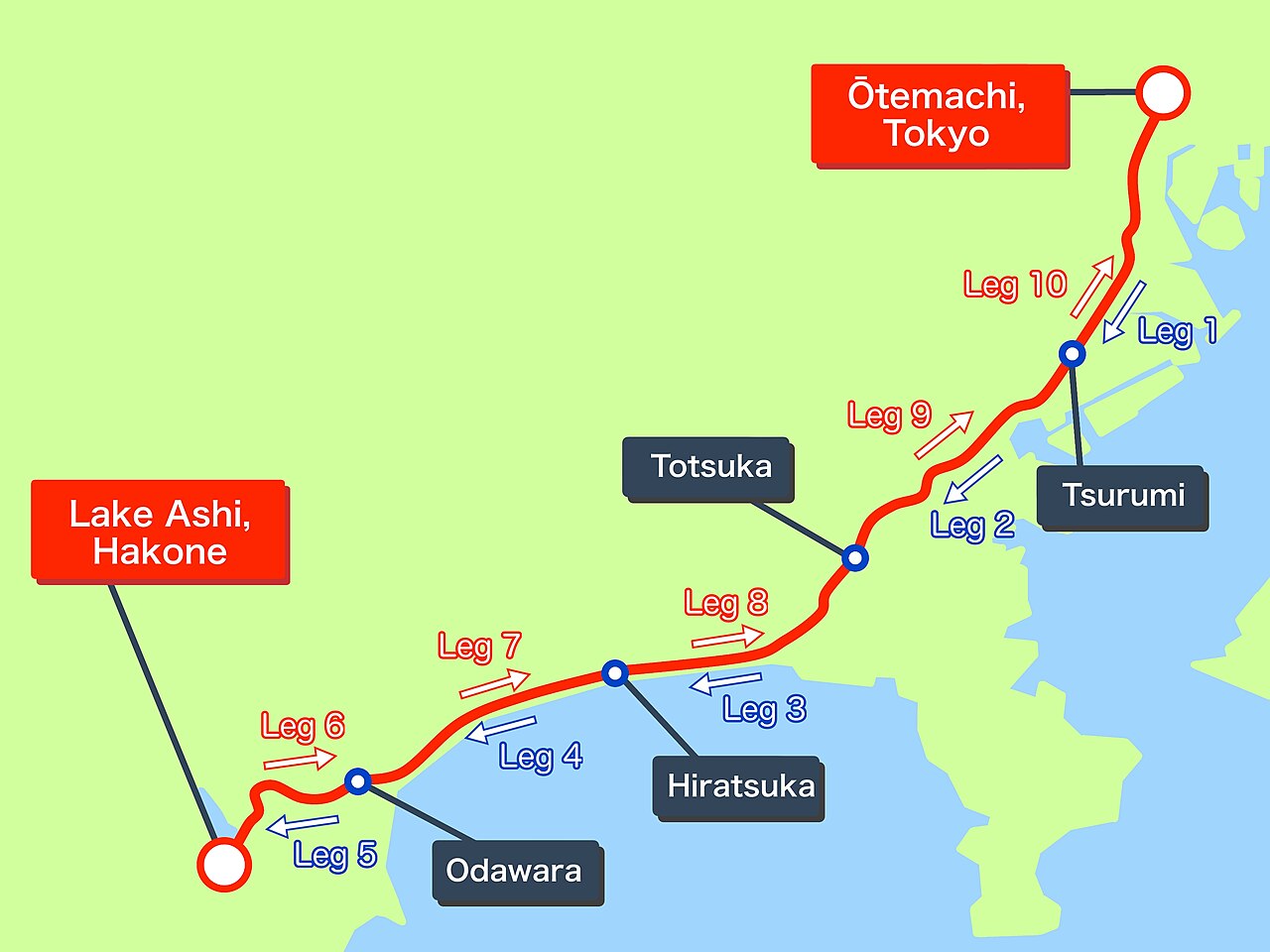
The Hakone Ekiden is a two-day, 217-kilometer road relay run by Japan’s top university teams between central Tokyo and the mountain resort town of Hakone, near Mount Fuji. The race was first held in 1920, making this year’s edition the 102nd. It’s the event Japanese distance runners grow up watching — like the Tour de France in cycling, it shapes recruiting, coaching careers, and public reputations. Each team fields 10 runners covering roughly half-marathon distances per stage, passing a traditional sash called a “tasuki” between teammates. This year, Aoyama Gakuin University won with a record time of 10:37:34, smashing their own course record by nearly 4 minutes. This made them the first university to complete two separate three-peats in the race’s history.
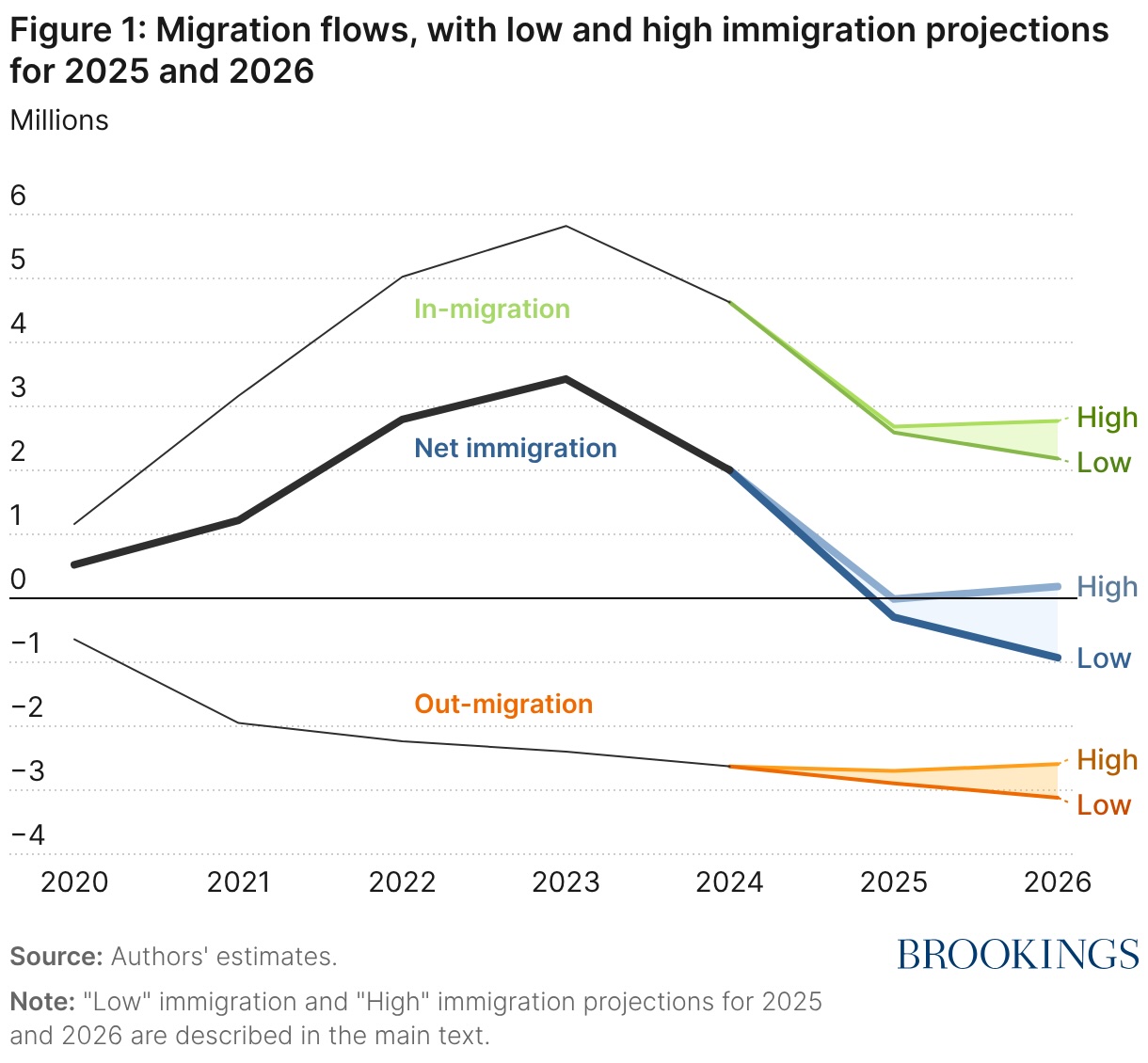
The United States — a country built by generations of newcomers seeking opportunity — recorded more people leaving than entering for the first time in at least half a century. A Brookings Institution report estimates net migration of -10,000 to -295,000 for 2025, a stunning reversal from 2.8 million arrivals just a year earlier. The shift stems less from deportations than from a sharp drop in entries, suspended refugee programs, reduced visas, and a chilling effect that’s kept would-be migrants away. Brookings warns the trend will dampen labor force growth, consumer spending, and GDP, with negative migration likely continuing into 2026. For a nation whose identity is woven from immigrant stories, the numbers mark an unsettling turning point.
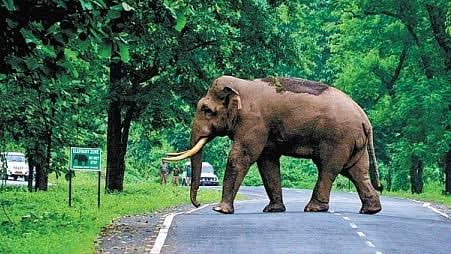
A lone male elephant has terrorized India’s Jharkhand state since January 1, 2026, killing at least 22 people in nine days. The single-tusked bull attacks under cover of darkness — striking villages, trampling victims in their homes, then retreating into dense forest by dawn. Victims include entire families, children, and even a professional elephant handler. Authorities believe the elephant may be in “musth,” a mating phase when testosterone surges make males extremely aggressive. Despite deploying 80 personnel, drones, and wildlife experts from neighboring states, officials have failed to track the animal, which crossed into Odisha state. Jharkhand has recorded 1,300 elephant-related deaths over 23 years amid escalating human-wildlife conflict driven by habitat loss.
Economy & Finance

Canadian Prime Minister Mark Carney’s January 14-17 visit to Beijing—the first by a Canadian leader in eight years — produced a landmark agreement aimed at resetting bilateral relations. Meeting with President Xi Jinping, Premier Li Qiang, and other top officials, Carney secured preliminary deals to slash canola tariffs from ~85% to 15% by March 1, with China also dropping duties on lobster, crab, and peas. In exchange, Canada will allow limited Chinese EV imports. The nations established new frameworks for energy cooperation (oil, gas, nuclear, renewables), financial dialogue, and law enforcement collaboration. Carney called it a “new era” in Canada-China relations amid rising U.S. trade tensions.
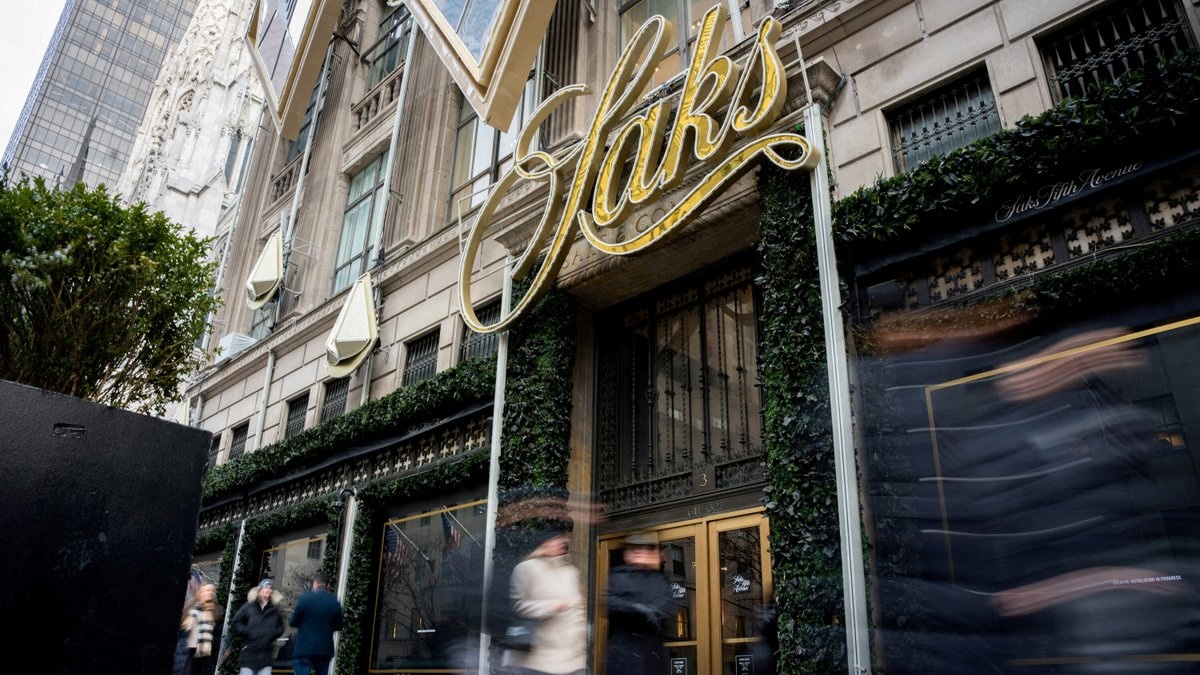
Luxury department stores Saks Fifth Avenue, Neiman Marcus, Bergdorf Goodman — names that defined American luxury for over a century — are now going bankrupt. Saks Global filed for bankruptcy on Wednesday, crushed by debt from its $2.7 billion acquisition of Neiman Marcus just over a year ago. The deal was supposed to create a powerhouse, backed by tech heavyweights Amazon and Salesforce. Instead, Saks couldn’t pay vendors, who began withholding inventory — leaving shelves bare during the critical holiday season. Running out of cash, Saks sold the Neiman Marcus Beverly Hills flagship last month and scrambled for emergency financing. “Department stores used to be the gateway to luxury,” notes Vogue’s Jenna Rennert. “Today, they’re the middleman that luxury brands no longer need.” Shoppers simply walk into Prada or Louis Vuitton directly.

A proposed California ballot measure — the 2026 Billionaire Tax Act — would impose a one-time 5% tax on net worth exceeding $1 billion, with a critical catch: it applies retroactively to anyone who was a California resident on January 1, 2026. This provision triggered a scramble among the state’s estimated 200-250 billionaires to flee before the deadline. Google co-founder Larry Page relocated business entities and purchased $173 million in Miami properties. Oracle’s Larry Ellison sold his San Francisco mansion. Venture capitalist Chamath Palihapitiya estimates $1 trillion in billionaire wealth has already left. Even Governor Newsom opposes the measure, warning it’s “really damaging.” Nvidia CEO Jensen Huang is a rare exception, saying he’s “perfectly fine” with paying.

OpenAI acquired health-tech startup Torch for a reported $60-100 million in equity—remarkable given that Torch was founded in 2024 with just four employees, had no publicly launched product, and existed for barely a year. The founders — Ilya Abyzov, Eugene Huang, James Hamlin, and Ryan Oman — previously worked together at Forward Health, an AI-powered primary care company that raised over $400 million before abruptly shutting down in late 2024. Torch’s “unified medical memory” technology, designed to aggregate fragmented patient data from hospitals, labs, and wearables into one AI-readable platform, solved a critical bottleneck for OpenAI’s newly launched ChatGPT Health. The timing proved serendipitous: Forward’s collapse freed a team with deep healthcare AI expertise just as OpenAI needed exactly that capability.
Nature & Environment

The Great Migration is the largest terrestrial mammal migration on Earth — a continuous, year-round movement of approximately 1.5–2 million wildebeest, zebras, and gazelles through the Serengeti-Mara ecosystem. The animals follow an 800 km clockwise loop between Tanzania’s Serengeti and Kenya’s Masai Mara, chasing rainfall and fresh grass in a cycle unchanged for thousands of years. January marks the start of calving season in the southern Serengeti and Ndutu region. Over 1.5 million wildebeest have gathered on the short-grass plains, with approximately 8,000 calves being born daily — totaling 500,000+ by March. The volcanic ash-enriched soil from ancient Ngorongoro eruptions produces nutrient-rich grasses ideal for nursing mothers. Calves stand within minutes of birth and run with the herd within three days — essential for survival as lions, cheetahs, hyenas, and leopards descend for the feast. Peak calving occurs in February, making January–March the prime window for witnessing this dramatic spectacle.
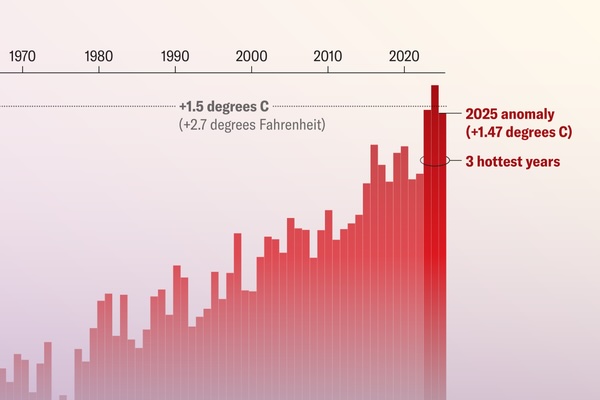
The year 2025 was the third-hottest in recorded history, according to the EU’s Copernicus Climate Change Service — trailing only 2024 (the hottest ever) and 2023 by a mere 0.01°C. Global temperatures averaged 1.47°C above pre-industrial levels, and for the first time, the three-year average (2023-2025) exceeded the critical 1.5°C threshold set by the Paris Agreement - a 2015 international treaty in which nearly 200 countries committed to limiting global warming to well below 2°C — and ideally 1.5°C — above pre-industrial levels by reducing greenhouse gas emissions. The past 11 years have now been the 11 warmest on record. What made 2025 particularly alarming: temperatures remained near-record despite La Niña’s cooling influence, which typically suppresses global heat. “The world is rapidly approaching the long-term temperature limit,” said Copernicus director Carlo Buontempo. “We are bound to pass it.”
Science

NASA’s Artemis II mission, scheduled to launch no earlier than February 6, 2026, will send astronauts beyond Earth orbit for the first time since Apollo 17 in 1972 — a 53-year gap. The 10-day mission will carry NASA astronauts Reid Wiseman, Victor Glover, and Christina Koch, along with Canadian Space Agency astronaut Jeremy Hansen, on a free-return trajectory around the Moon. Glover will become the first person of color and Koch the first woman to travel to lunar distance. The mission will test the Orion spacecraft - made by Lockheed Martin - for its life support and navigation systems, paving the way for Artemis III, which aims to land astronauts on the lunar surface by 2028.

What if the Big Bang wasn’t the start of everything — but merely a transition? Nobel laureate Roger Penrose, now in his 90s, proposes a radical alternative: our universe is just one stage in a potentially infinite cycle of cosmic extinction and rebirth. Here’s how it works: The universe expands, matter clumps together, and eventually gets swallowed by supermassive black holes. Over unimaginable timescales, those black holes evaporate, leaving behind a cold, empty cosmos. That dying universe then becomes the seed for the next Big Bang. Penrose claims faint “Hawking points” — hot spots in the cosmic microwave background — are echoes from a previous universe. Most cosmologists remain skeptical. But it’s a poetic idea: our universe as one chapter in an eternal story with no first page.
Lifestyle, Entertainment & Culture

The 83rd Golden Globes on January 11 crowned Hamnet as Best Picture (Drama) and One Battle After Another as Best Picture (Musical/Comedy). Beijing-born Chloé Zhao — who made history in 2021 as the first woman of color to win the Oscar for Best Director (Nomadland) — directed, co-wrote, produced, and edited Hamnet, an adaptation of Maggie O’Farrell’s novel about Shakespeare’s family and the death of his son. Jessie Buckley won Best Actress (Drama) for the film. Timothée Chalamet took Best Actor (Musical/Comedy) for Marty Supreme. Paul Thomas Anderson’s political satire One Battle After Another — starring Leonardo DiCaprio as an ex-revolutionary — swept the comedy categories with four wins including directing and screenplay.
Sports

[Table Tennis] Chinese table tennis star Fan Zhendong celebrated his first title in Germany as his club Saarbrücken lifted the German Cup after a 3-1 victory over Fulda-Maberzell at the Liebherr Cup Final Four in Neu-Ulm. In front of a record crowd of 5,200 spectators at the ratiopharm arena, the Olympic champion played a decisive role, defeating Dimitrij Ovtcharov and Ruwen Filus both in straight games. For Saarbrücken, it was the club’s third cup victory after 2012 and 2022. “It was my first Cup Final Four, and it was a special moment in my career,” said Fan. The victory marks the first step in the club’s ambitious “triple mission,” with further title opportunities ahead in the Bundesliga and Champions League.

[Soccer] Real Madrid’s nightmare start to 2026 continued on January 14 when Albacete — a team from Spain’s second division — knocked them out of the Copa del Rey with a stunning 3-2 upset. The defeat was a disastrous debut for new manager Álvaro Arbeloa, appointed just two days earlier after Xabi Alonso was fired. Despite controlling the ball for most of the match, Madrid conceded a heartbreaking goal in the 94th minute from Jefte Betancor — seconds after they thought they’d forced overtime with a late equalizer. It was Madrid’s first-ever loss to Albacete in 15 meetings between the clubs. Combined with their Super Cup final defeat to Barcelona days earlier, Madrid have now been eliminated from two competitions in a single week.
This Day in History

British super rock band Led Zeppelin is arguably the heaviest, most sonically powerful rock band in history — progenitors of hard rock and heavy metal whose crushing riffs and raw intensity obliterated everything before them. John Bonham’s earth-shaking drums hit like artillery. Jimmy Page’s distorted guitar carved through speakers like a chainsaw. Robert Plant’s primal wails pushed the human voice to its limits. Together they forged a blueprint spawning generations of metal from Black Sabbath to Metallica. Fifty-seven years ago on Jan 17, 1969, their self-titled debut album dropped in the US — recorded in just 36 hours, delivering a heaviness radio had never heard. It has since sold over 10 million US copies and become one of the most famous rock albums of all-time. As the Rock and Roll Hall of Fame declared, Led Zeppelin was “as influential in the 1970s as the Beatles were in the prior decade” — except louder, heavier, and far more dangerous.
Art of the Week

Banksy, the anonymous British street artist whose satirical works have appeared on walls from London to Gaza, has spent decades mocking the art establishment while becoming one of its most valuable commodities. In October 2018, he pulled off art history’s greatest prank. Seconds after his Girl with Balloon sold for $1.4 million at Sotheby’s London, a hidden shredder activated inside the gilt frame, slicing the canvas into ribbons as stunned bidders watched in disbelief. The stunt could have destroyed the work’s value. Instead, it created a legend. Re-authenticated and renamed Love is in the Bin, the partially shredded canvas returned to the same auction house in October 2021. It sold for $25.4 million — 18 times the original price. Sotheby’s went to great lengths ahead of the 2021 sale to make sure Banksy was not planning any additional funny business. They weighed the framed canvas to make sure there were no hidden components and double checked that the batteries had been removed from the shredder. Banksy had set out to mock art market absurdity. Instead, he accidentally proved its most perverse truth: even destruction is just another form of appreciation.
Funny

Previous Issues
January 03, 2026, An Incredible Journey From Wuhan To Singapore
December 27, 2025, The Age of One-Person Billion Dollar Company
December 13, 2025, So Many AI Reports, So Little Time to Read
Thanks for reading! If you enjoy this newsletter, please share it with friends who might also find it interesting and refreshing, if not for themselves, at least for their kids.
Last modified on 2026-01-17
Perfect for offline reading and printing • 5.3 MB
Download PDF version